History Nerd Approved: 10 Ancient Cities You Need to Visit
From the Colosseum to Machu Picchu, some places have been around for thousands of years. Here’s where to find ancient history that’s actually worth the hype.

There’s something about walking through a city that’s been standing for millennia. The cobblestones under your feet have seen empires rise and fall. The ruins you’re looking at? They were once the Burj Khalifas and Empire State Buildings of their time. And the best part? You don’t need a time machine or a history degree to experience it—just a plane ticket and a little curiosity.
If you’ve ever wanted to stand where gladiators fought, walk through temples that predate modern borders, or eat dinner in a square that’s been a meeting point for thousands of years, you’re in the right place. These aren’t just old cities—they’re living, breathing time capsules where ancient history meets modern life.
So grab your camera, charge your phone (you’ll need it), and let’s walk through some of the oldest, most fascinating cities you can visit on a group trip with EF Ultimate Break.

Visitor admiring the Erechtheion temple at the Acropolis in Athens, Greece
1. Athens, Greece
Let’s start with the big one. Athens has been continuously inhabited for over 3,400 years, making it one of the oldest cities in the world. But it’s not just old—it’s foundational. This is where democracy was born, where philosophy became a thing, where the foundations of Western civilization were literally built on a hill.
The Acropolis isn’t just a tourist attraction—it’s a 2,500-year-old architectural masterpiece that’s still standing despite earthquakes, wars, and questionable restoration attempts over the centuries. The Parthenon, dedicated to the goddess Athena, was already ancient when the Roman Empire was just getting started. Standing up there, looking out over the sprawling city below, you get a sense of just how long humans have been figuring things out in this exact spot.
But Athens isn’t stuck in the past. The Plaka neighborhood at the base of the Acropolis is full of winding streets, family-run tavernas, and shops selling everything from handmade sandals to tourist trinkets. You can spend your morning exploring 2,000-year-old ruins and your evening eating souvlaki at a rooftop bar with views of those same ruins lit up against the night sky. It’s the perfect mix of ancient and modern, and it’s why Athens stays one of the most interesting cities in the world.

Group of travelers visiting the Parthenon on the Acropolis in Athens, Greece
2. Rome, Italy
Rome wasn’t built in a day—more like 2,800 years. And somehow, despite everything that’s happened since then, it’s still here, still thriving, and still absolutely packed with history at every turn.
The Colosseum is the obvious headliner. This massive amphitheater has been standing since 80 AD, and it’s still one of the most recognizable structures on the planet. Walking through it, you can almost hear the roar of 50,000 spectators watching gladiator battles. It’s surreal to think about the engineering that went into building something like this nearly 2,000 years ago—and the fact that it’s still standing is a testament to Roman ingenuity.
But Rome is so much more than one monument. The Roman Forum, once the center of political life in ancient Rome, is now a sprawling archaeological site where you can walk among the ruins of temples, basilicas, and government buildings. The Pantheon, built in 126 AD, still has the world’s largest unreinforced concrete dome—and it’s in better shape than most modern buildings. Trevi Fountain, the Spanish Steps, the Vatican—everywhere you turn, there’s another layer of history.
Rome is still a living city. You’re not just visiting a museum—you’re eating cacio e pepe in a trattoria that’s been family-run for generations, walking on cobblestones that have been there for centuries, and experiencing a city that’s managed to preserve its past while fully embracing the present.

Friends posing together in front of the Colosseum in Rome, Italy
3. Cairo, Egypt
If we’re talking about old, we need to talk about Egypt. Cairo itself has been around for over 1,000 years, but the ancient sites nearby? They make most other “old” cities look like they were built yesterday.
The Pyramids of Giza are roughly 4,500 years old. Let that sink in. These structures were already ancient when Cleopatra was alive. They’re older than written history in most parts of the world. Standing in front of the Great Pyramid, you can’t help but feel small—not just because of its size, but because of the sheer weight of the passage of time since it was built.
The Sphinx, the temples of Luxor and Karnak, the Valley of the Kings—Egypt is essentially one giant open-air museum of human achievement. And Cairo, chaotic and vibrant and overwhelming in the best way, is your gateway to all of it. The city itself is a fascinating mix of Islamic architecture, bustling markets, and modern neighborhoods, all coexisting in a way that somehow makes perfect sense once you’re there.
Exploring Egypt with a group means you get the insider access—expert guides who can explain the hieroglyphics, the history, the stories behind the stones. Because as impressive as these sites are in person, understanding their reason for being makes the experience even more “whoa.”

Traveler at the Great Sphinx with the pyramids of Giza, Egypt
4. Machu Picchu, Peru
Machu Picchu isn’t an inhabited city anymore, but it’s one of the most significant ancient sites in the world—and it’s totally worth the journey. Built during the time of the Inca Empire around 1450 AD and abandoned just over a century later during the Spanish conquest, this mountaintop citadel remained hidden from the outside world until 1911.
Getting there is part of the experience. You’ll travel through the Sacred Valley, past terraced hillsides and traditional Andean villages, before taking a train through the cloud forest to the base of the mountain. Then comes the moment you’ve been waiting for: emerging from the Sun Gate or arriving by bus to see the entire city spread out before you, perched almost impossibly on a ridge between two peaks, with the Andes rising all around.
The engineering alone is mind-blowing. The Incas built this entire complex without wheels, iron tools, or written language—just stone, ingenuity, and a close personal understanding of their environment. The precision of the stonework, where blocks fit together so tightly you can’t slide a piece of paper between them, still baffles modern engineers.
But Machu Picchu is more than just bonkers construction. It’s a spiritual place, built in harmony with the surrounding mountains, which the Incas considered sacred. Standing there, surrounded by peaks and clouds, you understand why they chose this spot. It’s the kind of place that makes you tiny, humbled by both human achievement and the power of Mother Nature.

Classic view of the ancient ruins of Machu Picchu in the Peruvian Andes
5. Florence, Italy
Florence might not be as ancient as Athens or Rome, but its history is no less significant. Firenze was the birthplace of the Renaissance, the cultural movement that basically dragged Europe out of the Middle Ages and into modernity. Walking through Florence is like walking through an art history textbook—except instead of pictures, you’re seeing the actual masterpieces.
The Duomo, with its iconic red-tiled dome designed by Brunelleschi, is impossible to miss. Construction began in 1296, and the cathedral is still one of the most impressive examples of Gothic architecture in the world. Inside the Uffizi Gallery, you’ll find works by Botticelli, Leonardo da Vinci, Michelangelo, and Raphael—basically the rock stars of Renaissance art.
But Florence’s real magic is in the streets. The Ponte Vecchio, a medieval bridge lined with jewelry shops, has spanned the Arno River since 1345. The Piazza della Signoria has been the political heart of the city for centuries. And everywhere you look, there’s another church, another palace, another reminder that this city was once the center of the artistic and intellectual world.

Panoramic view of Florence's historic skyline featuring the Duomo, Italy
6. Venice, Italy
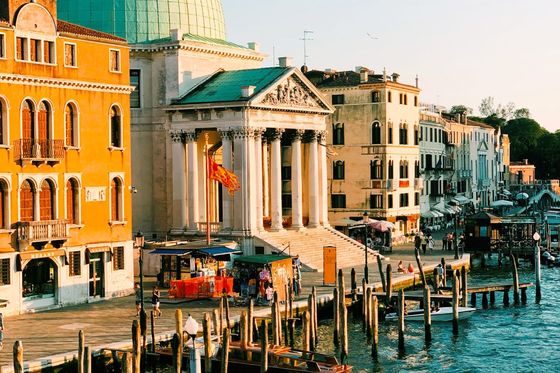
Italy again?! Venice is only about 1,600 years old, which makes it practically a baby compared to some cities on this list. But what it lacks in age, it makes up for in sheer audacity. This is a city built atop a lagoon on wooden pilings driven into the mud—a defiant middle finger to the very ideas of logic and gravity.
The result is one of the most unique cities in the world. No cars, no roads—just canals, bridges, and narrow pedestrian walkways that twist and turn in ways that make Google Maps almost completely useless. St. Mark’s Basilica, with its Byzantine domes and golden mosaics, has been standing since 1092. The Doge’s Palace, once the seat of Venetian power, is a masterpiece of Gothic architecture.
But Venice is also sinking, slowly but surely, which adds a bit of urgency. This is a city that won’t be around forever, at least not in its current form. Walking through it feels like stepping into a different era—one where beauty and impracticality went hand in hand, and somehow, it worked.

Traditional canal scene with bridges and colorful buildings in Venice, Italy
7. Prague, Czech Republic
Prague has been around since the 9th century, and it’s managed to survive wars, occupations, and regime changes with its historic center amazingly intact. The result is a city that feels like a fairy tale—all Gothic spires, Baroque palaces, and cobblestone streets.
Prague Castle, perched on a hill overlooking the city, is the largest ancient castle complex in the world, and has been the seat of power for Czech rulers for over a thousand years. The Charles Bridge, built in 1357, is lined with statues and offers some of the best views in the city. The Old Town Square, with its famous Astronomical Clock, has been the heart of Prague since the 10th century.
What makes Prague extra special is how well-preserved it is. Unlike many European cities, Prague wasn’t heavily bombed during World War II, so much of its medieval and Baroque architecture remains intact. Walking through the city feels like time travel—except with better coffee and cheaper beer.

Colorful rooftops and historic spires of Prague's Old Town, Czech Republic
8. Barcelona, Spain
Barcelona’s history goes back over 2,000 years to its founding as a Roman colony. You can still see remnants of the ancient city walls in the Gothic Quarter, where narrow medieval streets wind between buildings that have been standing for centuries.
But what makes Barcelona unique is its historical layers. Roman ruins sit next to Gothic cathedrals, which sit next to Modernist masterpieces by Antoni Gaudí. The Sagrada Família, Gaudí’s unfinished basilica, has been under construction since 1882—and it’s still not done. Park Güell, with its colorful mosaics and whimsical architecture, feels like stepping into a dream.
The Gothic Quarter is the heart of old Barcelona, where you can wander through medieval streets, stumble upon hidden squares, and find yourself at the Barcelona Cathedral, which has been kicking since the 13th century. It’s a city that honors its past while constantly reinventing itself.

Sunset view of Tibidabo and the Sacred Heart Church overlooking Barcelona, Spain
9. Paris, France
Paris started as a Roman settlement called Lutetia around 250 BC, and it’s been a major European city ever since. The Île de la Cité, the island in the Seine where Notre-Dame lives, is where it all began—and it’s still the geographic and spiritual heart of the city.
Notre-Dame itself, even after the devastating 2019 fire, is one of the most important examples of Gothic architecture in the world. Construction began in 1163, and the cathedral has witnessed coronations, revolutions, and centuries of Parisian life. The Louvre, originally built as a fortress in the 12th century, is now the world’s largest art museum.
But Paris isn’t just about monuments. It’s about the way history is woven into everyday life—the cafe where Hemingway used to write, the bridges where lovers have been attaching locks for decades, the neighborhoods that have retained their character despite centuries of change. It’s a city that takes its history seriously, but always with a dash of whimsy and glamour.

The iconic Eiffel Tower lit up at twilight in Paris, France
10. London, England
London was founded by the Romans around 43 AD as Londinium, and you can still see traces of that ancient city if you know where to look. The London Wall, parts of which still exist, once encircled the Roman settlement. The Tower of London, built by William the Conqueror in 1066, has served as a royal palace, a prison, and a fortress over its nearly thousand-year history.
Westminster Abbey, where British monarchs have been crowned since 1066, is a shining example of Gothic architecture. The British Museum houses artifacts from ancient civilizations around the world, including the Rosetta Stone and the Elgin Marbles. And throughout the city, you’ll find even more history—medieval churches next to Victorian buildings next to modern skyscrapers.
What makes London fascinating is how it’s constantly evolving while maintaining deep connections to its past. You can have breakfast in a cafe that’s been serving tea since the 1700s, spend your afternoon exploring Roman ruins, and end your day at a chic restaurant in a converted warehouse. It’s a city that refuses to choose between old and new—it just does both, and it does them brilliantly.

Travelers exploring London with Big Ben and Westminster in the background, England
Why ancient cities hit different
There’s something about visiting places with so much history that changes your perspective. Standing in the Colosseum or walking through the Acropolis isn’t just about seeing cool old buildings—it’s about connecting with the millions of people who came before you. It’s realizing that humans have been figuring out life, love, politics, and art for thousands of years, and we’re all part of that same ongoing story.
These cities aren’t museums. They’re real places where people go to work, raise families, and live their lives, just like people have been doing for centuries. And that’s what makes them so powerful. You’re not just observing history—you’re walking through it, eating in it, experiencing it firsthand.
With EF Ultimate Break, you get to explore these ancient cities guided by experts who know all the stories and hidden spots. Everything’s planned—the flights, the hotels, the must-see sites—so you can focus on actually experiencing these incredible places instead of stressing about logistics. And because you’re traveling with a group, you get to share those “uhhh, we’re actually standing in the Colosseum” moments with people who are in as much awe as you are.
Whether you’re a history buff or someone who just thinks old stuff is cool, these cities deliver. They’re proof that some things really do stand the test of time—and they’re waiting for you to come see them for yourself.
Key takeaways
- Athens, Rome, and Cairo are home to some of the world’s most iconic ancient sites, from the 2,500-year-old Acropolis to the 4,500-year-old Pyramids of Giza—proof that great architecture stands the test of time.
- Machu Picchu offers a different kind of ancient experience: an Incan citadel built into the Peruvian Andes in 1450 AD, showcasing incredible engineering that has survived centuries at 8,000 feet above sea level.
- European cities like Florence, Venice, Prague, Barcelona, Paris, and London layer centuries of history on top of each other—Roman ruins next to Gothic cathedrals next to modern life, all coexisting in fascinating ways.
- EF Ultimate Break handles the logistics—flights, hotels, expert guides, and itineraries—so you can focus on actually experiencing these ancient cities instead of stressing about planning.
Know before you go
The answers to your questions about visiting the world’s most ancient spots.